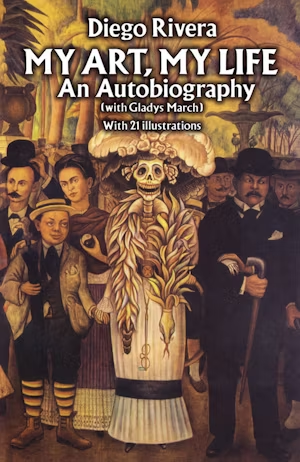
Luckily, Gladys March, the co-author of My Art, My Life by Diego Rivera, warns in the forward to the book that Rivera was a mythologizer, or mythomaniac. His exaggeration is part of his voice, she says, necessary for an accurate portrait.
In this autobiography, Rivera tells some stories about his childhood: between two and four years of age he was allowed to roam the woods with only a goat to watch over him; he had his first sexual experience at 9 with a voluptuous 18-year-old; at 10, he was a military genius who astounded the generals. Hmmm.
The bulk of the book emphasizes his dedication to painting. He describes individual murals and what he hoped to accomplish in them; we hear his side of the many controversies he was embroiled in. There are opinions about his contemporaries, his travels, and studies.
Viewpoints on the Mexican political scene, his belief in communism and dislike of capitalism appear throughout. He proclaims a love for the peasants, but the stories he tells are all about the wealthy heads of government and business who sought his company and bought his paintings.
Women, his four wives and numerous sexual exploits, make up the third major part of his story. He looks at them with an artist’s eye: “Lupe was a beautiful, spirited animal…the curves and shadows of that wonderful creation…” The end of the book has a short essay from each wife.
Usually when we hear about Rivera, it is about his accomplishments, his painting genius. In this book, we hear his opinions in his own voice. He doesn’t do himself any favors. He had a large ego that craved attention, a disdain for conventions, and a love of chaos and excitement. (Sound familiar?) He saw the world from a different perspective. Maybe it is too hard for someone to be a revolutionary artist and conventional at the same time.
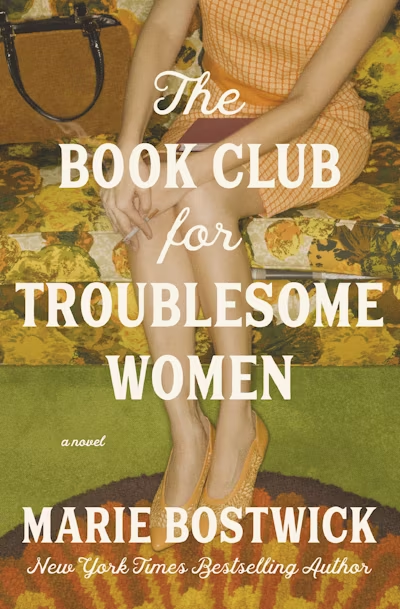
When Margaret moved into her new community, she was looking for a friend. She didn’t mean to start a book club and she didn’t mean to read The Feminine Mystique, but that is what happened.
In The Book Club for Troublesome Women, Marie Bostwick tells about life in the 60s and how Friedan’s book was one of the sparks that started the women’s movement. For Margaret and her three friends, it was life changing. We follow these traditional housewives and mothers into their first forays with careers, business, and higher education.
At first, I wasn’t impressed with Bostwick’s book. The fact that there could be more to a woman’s life than housekeeping is no longer news. But for the younger generations who didn’t live through the 60s, the potential tradwives, it might be an eye opener.
One of the best parts of the book is the message of the importance of support and help that friends can give to each other. This is a fine piece of social history told through the voices of four thoughtful gutsy women.

The title of Martin Walker’s To Kill a Troubadour brings to mind that well-known title, To Kill a Mockingbird. In addition to the phrasing, there are the two words, troubadour and mockingbird. Both refer to things that are musical and sing. Why did Walker want to make the connection?
Google’s AI reminded me that Harper Lee’s mockingbird symbolizes innocence. In Walker’s story, a young French troubadour has written a song about Catalan independence (the province of Spain that Walker expounds on). His lovely folk song has become embroiled in a political firestorm. Spain wants to ban it; France is incensed that one of their own is being censored. But is the problem really between these two closely related countries or is there a third-party lurking in the background manipulating the situation?
Walker is very interested in the minute details of French Perigord history (his second home). This book reflects that interest as well as international espionage, military history and weapons. It also gives a nod to devotees of the more personal, cozy mystery genre with a second story line about a woman whose abusive ex-husband has been released from prison.
One of the best parts of Walker’s books are the endearing details about life in the small village of St Denis, especially the delicious food and wine. His main character, Bruno, casually whips up simple feasts featuring gazpacho from his garden vegetables or capon from the local butcher. I’m always so impressed with his hospitality. Bruno routinely invites old friends, people he has just met, or casual business acquaintances to dinner at his house. Out-of-town visitors are offered his guest room. His generosity creates a feeling of community and is an example to us all.

I’d like to offer a tribute to Jane Goodall who recently died at age 91. Jane was a pathfinder, true to herself, who worked at something she loved and believed in until the day she died. We should all be so lucky.
Discover more from Old Ladies Read and More
Subscribe to get the latest posts sent to your email.