Mixed Reviews

Netsuke, intricately carved objects approximately two inches tall that were worn with men’s kimonos in Japan, are the subject of The Hare with Amber Eyes.  The author, Edmund De Waal, tells us about his collection of over 200 and how it was passed down to him through several generations.

This is a story of his Jewish family who were at home throughout Russia, Paris and Vienna. Wealthy and cultured, they were friends with Proust and Renoir.  Their magnificent, lavish homes contained precious paintings, furniture, jewels – and netsuke.

De Waal, who is a potter, has a feel for beautiful things – and he is very interested in exactly how the netsuke feel when picked up. This is a story that would appeal to the artist who loves the details of color and design.  It is a story that would appeal to the historian; De Waal’s ancestors who owned the netsuke, starting in the mid-1800s, are brought to life in the settings of the times – first Paris, then Vienna. 

While I appreciate the portrait of the cultural life of different eras, I’m just not interested in the details of so many “things.”  I prefer a book that talks about ideas, makes perceptive observations. This one finally came to life for me about three quarters of the way through, when the Nazis invaded Vienna, and went after the Jews.  De Waal describes the scene in present tense.  His family’s home is invaded by the Gestapo, their beautiful desk thrown out the window, their paintings inventoried and taken away, even the jewels and rings they are wearing are stolen.  They are forced to live in two dark rooms while the Nazis who revile them move into the rest of their family home.  We see the devastation of war that does not take place on the battlefield. 

The second generalization raised by this book is that not only the poor, but the super-rich, will always be with us. I couldn’t help but compare this fabulously wealthy family with those whose stories make the news today.  And this moral question: would I be as sympathetic if certain current homes were invaded and their things appropriated? 

So – a mixed review on this book.  Some interesting perceptions about life in general (if you look), but the main thrust is the luxurious lifestyle lived by this family of collectors for whom valuable netsuke were only a nominal part.

Each day of work, Sam would put on his neutral clothes and neutral persona and go to visit white men all over the rural south because they had something he wanted.  Sam worked for a small environmental company engaged in buying freon on the secondary market from people who had leftover cans stored in their barns and garages.

The freon, an environmentally destructive gas, was then destroyed.  Doing so gave them points to sell to large companies looking for environmental offsets. They earned enough to make a profit and do something for the environment.

Sam’s adventures are the story part of After Cooling by Eric Dean Wilson, the full title of which includes On Freon, Global Warming, and the Terrible Cost of Comfort. As often is the case, a story is needed to make scientific information palatable to us nonscientists in the general public.  This book starts with an explanation of how cooling occurs, moves on to what artificial cooling methods have been used in the past, and ends with the large-scale expectation of and availability of air-conditioning both in our homes and automobiles.

This easy accessibility of temperature control arose because of the invention of freon, thought to be a harmless refrigerant. Wilson takes us through the eventual recognition that it was causing changes in the atmosphere and leading to the destruction of ozone, a gas necessary to life on the planet. We learn of the eventual banning of its production although the use or sale of what had already been produced is still allowed.

From his discussion about air-conditioning, Wilson segues into the more serious topic of global warming. He moves from science into philosophy on the causes of the problem and the changes in mindset needed to solve it. He would like us to think about communal health in a world of finite resources.  Do we really want to bequeath rises in seas, burning forests, monstrous winds, and food scarcity to our grandchildren?

I liked this book because of the general discussion about the problems of global warming and some of the specific thoughts about what to do about this very important subject.  I understand that a scientist must provide facts to his peers, but I found them difficult to follow.  I also found the other end, his philosophy, obscure. So – another mixed review – an important work, well researched, thoughtful, but I was glad when I had finished this “good for me” book.

Dorothy Sayres has been one of the best-known mystery writers, along with Agatha Christie, for years. Her most popular Gaudy Night was written in the 1930s and is one of the last of the Peter Wimsey series.

Harriet Vane has been invited to a gaudy, or celebration, at her old college. She re-establishes contact with old friends and a long-lost way of life. But there is trouble. The staff is receiving nasty letters and there has been malicious damage to the buildings. Harriet, a detective fiction writer and assistant to private investigator Peter Wimsey is asked to help. 

The backdrop for the story is a detailed portrait of academic life in an Oxford affiliated women’s college in the 30s.  The subject is whether women should receive an academic education rather than prepare themselves to be housewives.  It is discussed endlessly, from all possible angles.  Can a woman both marry and have a professional life?  If so, which should take precedence?  Is the academic obligated to stay single (and celibate)? This philosophical debate is personified in Harriet and Peter’s love affair.

How pertinent are these questions to a 21st century reader?  Sadly, almost a hundred years later, they are still relevant, but not enough to make up the majority of the book, or to overtake the question of the destructive “poltergeist.”  Gaudy is interesting for its history of women’s rights in academia, but I will look for a more current writer for my mysteries.

“Birdwatching Can Help Slow Aging.” is a headline that grabbed my attention. As a birder I’m interested!   

Many popular science magazines are reporting on research published in the Journal of Neuroscience. Bird watching, a complex skill, contributes to neuroplasticity, the ability of the brain to continue to restructure itself and adjust functions even in our senior years.  And like anything else, the more it is exercised, the better the brain can perform.  Learning a new language or playing a musical instrument does a similar thing, but the study on preserving mind function was done on bird watchers. 

Manu-o-Ku
White Tern, Hawaii

Choice and Reflections

What a pleasure to read that the characters I had come to dislike, cruel hateful people, brought about their own destruction through their evil behavior. How just and satisfying. 

But what about the others? Well, this isn’t a fairy tale. In Nathan Harris’s The Sweetness of Water, there is no “other side;” there are no knights in shining armor. There are just ordinary people, full of flaws, who stumble through life, usually doing what is easiest. But the opportunity to do something that matters comes to them. The ones who make the brave choice are not immediately showered with success and happiness.

The setting is the South at the end of the Civil War when slaves have just been emancipated, and Confederate soldiers are returning home.  Two young black men, freed slaves, are living in the woods, making their way to one of the tent cities that have sprung up.  Two white men, soldiers about the same age, best friends since school, have just come home.

One set of parents welcomes the social changes. They have often held views that were different from their small-town neighbors, and they do so now when they employ the two freed blacks to work on their farm and pay them fairly. The other set of parents insists that things will go back to how they rightfully were. Maybe the Negroes won’t be slaves, but they will be kept in their place.

The returning school mates share a secret that, when exposed, becomes the match to the tinder. Deep seated prejudices explode, damaging more lives than the war.

When I heard that Olga Tokarczuk had a new book, I put myself on the waiting list.  I loved Drive Your Plow Over the Bones of the Dead, the book she won a Nobel prize for. 

But House of Day, House of Night isn’t new.  It was written twenty years before Plow, and has just been republished to take advantage of the interest in her since she won the Nobel in 2018.

The term for it is “constellation” novel. There are fragments of stories, ideas, observations, which range from one page to a full chapter.  The main character, who is unnamed, lives in a small rural town in Poland with her husband/partner R.  She tells about her days walking in the woods and mushroom hunting. (I never heard of so many unusual kinds.)  There is an elderly neighbor, a wig maker, who emerges only in the spring. They tell each other folk tales such as the one about Saint Kummernis, written by a monk who very much wanted to be a woman. 

In the book, one subject sparks another and Tokarczuk doesn’t hesitate to move from one odd, creative idea to another.  Two or three characters return periodically to give the book some cohesion.  There is the recurrence of her online dream group, people who post their dreams from the previous night. We are taught the history of the area which had originally belonged to Germany but is now repopulated with Poles from the eastern part of Poland which had been ceded to Russia.

I love her use of metaphor, personification in particular, which is creative and edgy. I have to remember though that this is a translation.  How much is Tokarczuk and how much is her translator?  Here are some favorites:

…the clouds drew aside, revealing the moon, suspended like a bombshell, which began to rise over the allotments, got tangled in the fruit trees, and then shot straight into the sky, clearly on view as it took possession of the entire earth.

The sun was slowly disappearing…the shadow on the floorboards was creeping farther forward…finally it reached our backs…painlessly and imperceptibly, it swallowed us.

Of interest to the gardeners out there: R tells the story of the slug family.  He describes the master of the house.  At night he glides through the grass…he eats wet lettuce and tender young zucchini shoots.  He enjoys gnawing holes in them, but it’s not out of malice – it is his form of creativity.

If you’re interested in something quirky, with regular pop ups of perceptive ideas, this is a book to try. If you want a traditional story, I’d pass.

The Busybody Book Club by Freya Sampson is one of those relaxing mysteries which are great to read on a lazy afternoon.  The coincidences that move the plot along are a little much but there are some unexpected twists, and I was glad to read something with a happy ending.

Nova has moved to a small Cornish town with her fiancé where, as part of her job in a community center, she starts a book club. One of the members, a Miss Marple wannabe with time on her hands, has many theories about murder.  Arthur, a caregiver for a wife unable to read any more, is looking for reading suggestions and company.  Ash, a gangly lovesick teen wants to impress a would-be boyfriend.

Trouble comes to the community center when money earmarked for a new roof is stolen.  When the mother of the prime suspect is murdered, the book group mobilizes to find the murderer and save the center and Nova’s job.

Great new word: Zoodle.  Zucchini is in the etymology, but etymology is not destiny. These days zoodle often means any vegetable noodle, even when no zucchini is involved.

If that bothers you, feel free to say swoodles (sweet potato), coodles (cucumber), or broodles (broccoli). Just don’t let the terminology spiral out of control, or you might end up with an impasta on your plate.

Ducks and Wolves

This lovely tone poem of a book details the ten weeks James Rebanks lived on a small island off the coast of Norway near the Arctic Circle. In The Place of Tides, he writes about the eider ducks who nest on the island and the woman who made that happen.

A century ago, collecting the down left behind by the ducks was part of a self-sufficient lifestyle.  People on the small outer islands fished teeming waters, ate eggs from massive flocks of birds, and sold the eider down.  Now, the natural habitat is so changed that the ducks need assistance to survive.

Anna had lived the expected life; she married, had children, worked at a job in town that she enjoyed. But she had heard about the independent women who lived on the outer islands caring for the ducks and had been taken there to visit by her father who also loved that lifestyle. When she was fifty, she answered an advertisement for a duck woman on one of the islands.

Each spring, during nesting, she lived on the island, building safe nest boxes and protecting the birds from predators.  She became an expert; she saw her duck numbers increase, and eventually brought the eiders back to an island they had abandoned. Recognition came from UNESCO, making this area a World Heritage Site. Twenty years later when Rebanks joined her, it was Anna’s last season with the ducks.

The pace of this memoir echoes the pace of life on the islands. Both are slow, deliberate, observant.  Rebanks notes the small changes as spring progresses, the bite of the wind, the swelling of peony buds.  We learn about their meals of fish, potatoes, and pancakes and how the three duck people pass the time on a rainy day.  There is the art of making a nest acceptable to a picky duck mother and a tremendous amount of hard physical work.

Is it worth it?  If the ducks are unable to survive on their own, should humans devote a large amount of time and resources to helping them (and by extension other endangered animals)? After a whole season of work by three people, there was enough eider to make two duvets.

If the payoff isn’t monetary, or usefulness to humans, what then?  What is intimacy with something wild worth?

I heard strange woodwind noises coming from under the floorboards.   Anna held up a hand like we should not move an inch.  A duck was chattering to herself eighteen inches beneath the sofa, perhaps to her mate outside in the grass, as she decided on a nesting place in the shadows beneath the house.

How could we give them up, these wild birds living the lives they’ve lived for millennia?  Isn’t there room for wildness in a 21st century world?  Where do we envision wilderness 200 years from now? These are the looming questions behind this quiet beautiful story.

When there is an artist whose work we love, we assume the producer is a wise and great person.  An actress who gives a moving performance must be empathetic; a writer who produces a perceptive book must be compassionate. Well, prepare to disabuse yourself of these ideas when you read The Award by Mathew Pearl. 

The top writers of the day, artists whose work we admire, who have won the big prizes, are as callow, jealous, and ambitious as can be.  They would do anything, anything, to be published, receive an award, be admitted to the “club.”  Such is the main character and many of the people he meets.

David is a gifted writer desperate to be published and acknowledged.  When he moves into a house and learns that the other tenant is a big-name successful writer whom he idolizes, he makes the mistake anyone would and assumes this is the break he has been waiting for. He is wrong and his idol is detestable. But David is no better. As he fights tooth and claw to get ahead, we see his career succeed, while his integrity disappears.

This is a wonderfully plotted story with an unnerving depiction of the need for success.  I understand that a person and his product are two different things. I drive a Tesla, after all. But getting to know the main character and watching his ascent/descent was just too painful.

When Louise Penny wrote The Black Wolf in 2024, she worried that the plot concerning an invasion of Canada by the US was too unrealistic.  Then came Trump.

Her previous novel, The Grey Wolf, which is actually the first half of a two-book whole, ends with the realization that the plot Chief Inspector Gamache and his staff had uncovered was only the first step.  There was still a problem.  But what else was going to happen?  They weren’t looking for the perpetrators of a crime – not yet – but trying to prevent something unknown. Whatever it was involved government officials, in both the US and Canada, at the highest level.

What develops is a sophisticated plot concerned with water supplies, mega forest fires, and global warming, all intertwined with power and greed.  Gamache matches wits with the black wolf to stop political chaos.

Three Pines, that mythical village of safety and home, plays a smaller part in this novel than others.  This might be all right.  There are only so many allusions to fresh hot brioche and seared Arctic char that a person can read.

Science and Mythology

Most stories about New York focus on the skyscrapers for the setting.  Manhattan Beach by Jennifer Egan turns attention away from the city to the sea, reminding us that NYC is one of the biggest ports in the world.

Our three main characters meet on the beach.  Eddie, the dad, brings his daughter Anna to meet Dexter, soon to be his new boss. It is the Depression, and Eddie, with a quasi-union/underworld job on the docks, needs more money. Dexter, with his mob connections, think he can put him to use. Anna has been brought along as the family Dexter wants to look over. Years later, after Eddie has disappeared, Anna will meet Dexter who probably knows, or was responsible for, what happened to her dad.

As World War II begins, Anna is working at the Brooklyn Navy Yard as an inspector, substituting for the men at war.  She watches the deep-sea divers in their heavy equipment who do underwater repairs.  Fascinated by them, she applies for the job, but it is the 1940s, and such dangerous work is not for a woman.  She perseveres and because of the dire need is eventually accepted.

Egan loves to intertwine her characters, jumping back and forth in time and space, showing us the growth, or at least change, in each one.  Anna was the most fully developed and tied the two men together.  Their stories weren’t so clear to me as I never understood exactly what motivated them or what they did wrong.  Hers was more typical, a sexual awakening, a woman wanting to work in a traditionally male job.

This is a historically accurate, well researched depiction of life at the time, the end of the depression, the beginning of the war at the Navy yard, nightclubs, prejudices.

Long ago, mankind lived in a liminal time. The world was filled with gods and goddesses, nymphs, monsters, and witches as well as mortals, often interacting. 

It was not unusual for a god to want a beautiful woman or to stir up the sea to sink a ship.  Humans met nymphs in the woods; princes spoke with goddesses.  Prometheus gave the gift of fire.

Giving us entrance to this time is Circe by Marilyn Miller. Circe was the daughter of sun king Helios and a nymph who was the descendent of a Titan. When she discovers her magical powers, and confesses them, Helios, and still more powerful Zeus, confer.  They are afraid of this womanly magic and exile her to a deserted island.  With nothing else to do, Circe patrols the island, learning the secrets of its herbs and developing ever more powerful potions.

Although she may not leave, others may come to her, and they do.  Daedalus, famous crafter of wings, brings her a loom.  Odysseus, exhausted on his way home from Troy, stops for supplies and stays through the winter.  A son, Telegonous, is born.

Circe used her solitude to discover who she was. She observes the mortals – how hard they must work to perfect a craft, and compares this to the gods who flick a finger to get what they want. Her portrayal of unlimited wealth and power is a timely warning. These ancient gods are cruel and care for nothing but themselves; even they are corrupted by too much power.     

In her mystery Primitive Secrets, Deborah Turrell Atkinson combines modern Hawaii with ancient lore. The main character, Storm, has just passed the bar exam. She is hired to work in the law office of her mentor and adoptive father. All is going well until she walks into the office one morning and finds him dead in his chair.

At first there is no reason to suspect anything other than natural causes.  But odd things start to happen.  She is mugged; she is run off the road while visiting her aunt on the Big Island; her boss’s briefcase is missing. 

Her visit to her aunt who is a traditional healer doesn’t give her the respite she wanted.  As she follows her to the mountains to look for medicinal plants, she hears noises in the bushes and sees a large pua’a, a pig-like shape.  Soon there is a strong floral smell, a Hawaiian warning.

As danger surrounds her, Storm makes use of her Hawaiian spiritual beliefs to ferret out fraud and murder in the law office.

HAPPY NEW YEAR TO ALL

Roles of Women

Both my reading groups chose short story collections this month.  I thought they would be easy reading. Sit down, relax, read a story. Not so. Each was dense, often with an unexpected ending that required rereading to see what I missed.

The first collection was Alice Munro’s Hateship, Friendship, Courtship, Loveship, Marriage.  True to its title it explored women’s relationships, often with men but female friends and relatives also. Close childhood friends, stepsisters, cousins drift apart and find it difficult to reconnect.  Life has moved on for one if not the other.

The women rarely do well in their relationships with men.  Some stories appear to be set in the 50s and talk about subjugation. Others are more timeless.  A man dealing with his wife’s fatal diagnosis flirts with a young girl hired to help while the sick wife waits in the overheated car.  A man infuriated by his work situation dies still ranting, oblivious to his wife’s feelings of loss.  A woman meets a man she had a crush on when they were children and hopes for a reconnection.  But a child of his has died and the walls around his current life are insurmountable.

Each of Munro’s short stories creates a scene with detailed descriptions of character and place. Events from the past weigh heavily on the situation and help set the mood.  When the climax comes, it is a jolt: maybe it is an unexpected surprise; it might be the upwelling of a deep complex emotion; or rarely, the revelation is just plain satisfying.

Munro’s stories are angry about the mistreatment of women. This is not a sentiment to be found in The Penguin Book of Japanese Short Stories. Written from the mid-1800s to the early 1900s, these stories depict the subservient lot of women in Japan as part of the background, hardly worth a comment.

The commodification and objectification of women in the stories is appalling to a twenty first century reader.  Without a bit of shame, men of a certain class abandon their wives and go out nightly to get drunk and evaluate the available prostitutes. No Christian moralizing here.  This behavior is expected.

Another theme is the devastation of war.  A woman muses on how her town has changed and realizes there are no dogs. The author leaves it to the reader to think about why not. In a different story, an eccentric old woman, unkempt and muttering, lives in a crumbling building (symbolizing traditional Japanese culture?) and remembers her prewar life when she was a published writer.

These stories were written as Japan was being changed by Western influence and the conflict between the two cultures was strongly felt. The first tale could not be more explicit.  A young man, travelling in Paris, is forced home to take on his family responsibilities and marry.  When he can endure the traditional life no longer, he leaves his wife for the debaucheries of the city.  After six months, he becomes ill and longs for the comfort his wife could provide. (He forgot she was pregnant when he left!) He returns home to the peacefulness of the country which he enjoys for about six months…

Written by many different authors over a period of one hundred years or so, this collection brings a perceptive slice of Japanese life.

Very different from the short stories is a memoir by Sasha taqwsablu LaPointe, a Salish author from the Pacific Northwest who writes about her troubled heritage in Red Paint.  She was assaulted when a young teenager, ran away from home, lived on the streets.  Mixed with her personal troubles was her intense anger at her ancestors’ treatment by whites.

The story is a litany of the troubles of a dysfunctional life – alcohol, sex, homelessness, PTSD. I felt she used writing this memoir as therapy and I found it tiresome to read.  Interspersed with her story were histories of some individual ancestors.  They could have been used to spark the book but were trite not perceptive. (They ate salmon and berries.) 

Does she feel that her ancestors’ mistreatment was the root cause of her problems? Her rage, now, still, at how Native Americans were treated was unexpected, but maybe this feeling is widespread. I thought about the problems on reservations with depression and alcohol and how psychologists are learning that trauma and injustice can be passed through generations.

LaPointe is a talented woman, a punk musician as well as writer who lives according to her native heritage and has learned to combine these apparently disparate interests. She talks about the meaning of red paint in her native culture and uses it in her performances.

We don’t hear many Native American voices from the Pacific Northwest and I was looking forward to reading this one.  She raises provocative questions about inherited trauma and identity, but there was so much anger. Mixed reviews!

An English professor wrote this sentence and asked the class to punctuate it properly:  A woman without her man is nothing.  The men in the class punctuated it as: A woman, without her man, is nothing.  The women in the class punctuated it as:  A woman: without her, man is nothing. 

Travel and Adventure

Under the streets of Paris, Robert Macfarlane slithered through tunnels so narrow he had to turn his head sideways to fit.  This exploration of the underground invisible city and its inhabitants is just one of his adventures in his nonfiction book Underland.

Macfarlane is fascinated with things underground. First there is the concept of it – dark, hidden, burials – and the connection with our own subconscious. Most of the book, however, is not about ideas but about the places he has explored.  He writes about caving to find subterranean hideouts, old cities, and underground rivers. He climbs glaciers to understand the secrets they held deep in ice, but which are now surfacing. He travels to almost inaccessible coastal caves in Norway’s Arctic Circle to see the dancing red figures on their walls.

Macfarlane is a superb nature writer who can write pages about the colors and sounds of glaciers and make you want to continue reading. He is an artistic observer of what we think of as the non-animate world – rocks, water, dirt. He notices their shape, texture, sparkle, smell, color: “I will remember the days that followed mostly as metals. Silver of the pass.  Iron of the bay and its clouds.  Rare gold of the sky.  Zinc of the storm in its full fury.  Bronze and copper of the sea…” He is also a brave adventurer – or crazy person – depending on your view of dangerous travel and extreme sport.

Macfarlane explores the uses of caves in the past – as burial sites, or secret hideouts during wartime. In the present, underground facilities store nuclear waste – as deep and inaccessible as possible. There is a seed bank, back-up in case of global catastrophe.  Physicists study the universe’s dark matter. (Yes, underground.)

The book is very dense and best read with a break between chapters.  It is possible to pick and choose.  If getting stuck in passageways deep underground terrifies you, read about the network of fungi and how they connect the above ground trees.  There are provocative ideas, nail-biting adventure, an abundance of unknown (to me) facts.

Two hardy, self sufficient young women ride their bicycles along the old Silk Road, the trade route that Marco Polo traveled that connected Europe and China.  In Lands of Lost Borders, Kate Harris tells of that ten-month grueling journey traveled by her friend Mel Yule and herself. They start in Istanbul and end in Nepal and India. It is a trip that could not be mistaken for a vacation.

The land is bleak and arid, alternately freezing and broiling, but the intrepid travelers see the best. They “travel through the stars” in the still hot desert night.  They navigate the washboard roads and bike up the passes in Tibet and Nepal.  Throughout the memoir, and again in the epilogue, Harris cites the kindness of strangers – people who fed them dinner and let them pitch their tent in the yard. One woman (a mother of four who was younger than they) washed their hair.

As Harris tells their story, she ruminates on many things.  What exactly is the use of a border?  How does wildlife conservation work in a poor country with a hungry population?  (This question after a police officer offered to share his lunch of lamb, made from the protected Marco Polo sheep he was hired to care for.) Why do we spend billions on space exploration when we don’t know what a rhino says when it snorts and sidles into the grass?  Harris’s far-flung philosophizing might be more interesting than the isolated places they visited.

Why do it?  Why go on a harrowing bicycle trip full of hardship and worry? A partial answer comes from Alfred Russell Wallace (co-discoverer of natural selection) who says that one of the essentials of life is “an adequate change of occupation.” Do something different! Or – some people just have adventure in their blood. 

The fields were honeyed with light as the sun set, and they gave off the warm smell of hay… another night on the Silk Road, with silence settling over the fields and the crickets resuming their own strange incantations, spells that conjured beads of dew from blades of grass and lulled us to sleep under a smoke of stars.

The Cat Who Went up the Creek is one of Lilian Jackson Braun’s delightful “The Cat Who” mysteries.  Charming and easy to read, it was the perfect respite after two serious travel books.  Qwilleran and his cat companions, Koko and Yum Yum, once again save the day and solve the mystery.

Qwill has taken a few days’ vacation, staying in a cabin on the river.  Koko, always mysteriously prescient, is suspicious of some of the neighbors.  What is really going on in the adjacent woods? are they taking photographs? panning for gold? or something more nefarious?  The plot moves at a leisurely pace with many diversions into the history of life “400 miles north of everywhere” and the quirky characters who live there.

In Jim Qwilleran, Braun has drawn a character that allows readers to indulge an almost universal fantasy.  What would it be like to suddenly inherit a fortune? (Billions in his case.) We can allow ourselves to identify with Qwill who has the energy, brains, and generosity to use it well, all while solving the latest murder.

I’ve always liked new words and plays on words and last month the No Kings movement produced a bonanza.  There was tactical frivolity, a form of protest involving humor and whimsy.  Or axolotl, a salamander native to Mexico and on the endangered list. 

It was occasionally the companion to amphifa, Portland’s now famous frog.  Then there is auntifa, seen next to photos of protesting old ladies.  And two favorites– Make America Read Again and MAGA: Make America Gracious Again. 

Different Paths

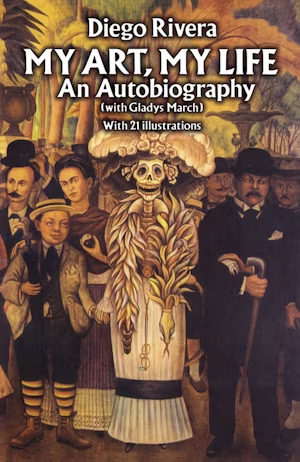
Luckily, Gladys March, the co-author of My Art, My Life by Diego Rivera, warns in the forward to the book that Rivera was a mythologizer, or mythomaniac.  His exaggeration is part of his voice, she says, necessary for an accurate portrait.

In this autobiography, Rivera tells some stories about his childhood: between two and four years of age he was allowed to roam the woods with only a goat to watch over him; he had his first sexual experience at 9 with a voluptuous 18-year-old; at 10, he was a military genius who astounded the generals.  Hmmm.

The bulk of the book emphasizes his dedication to painting.  He describes individual murals and what he hoped to accomplish in them; we hear his side of the many controversies he was embroiled in.  There are opinions about his contemporaries, his travels, and studies. 

Viewpoints on the Mexican political scene, his belief in communism and dislike of capitalism appear throughout.  He proclaims a love for the peasants, but the stories he tells are all about the wealthy heads of government and business who sought his company and bought his paintings.

Women, his four wives and numerous sexual exploits, make up the third major part of his story.  He looks at them with an artist’s eye: “Lupe was a beautiful, spirited animal…the curves and shadows of that wonderful creation…” The end of the book has a short essay from each wife.

Usually when we hear about Rivera, it is about his accomplishments, his painting genius. In this book, we hear his opinions in his own voice. He doesn’t do himself any favors.  He had a large ego that craved attention, a disdain for conventions, and a love of chaos and excitement. (Sound familiar?) He saw the world from a different perspective. Maybe it is too hard for someone to be a revolutionary artist and conventional at the same time.              

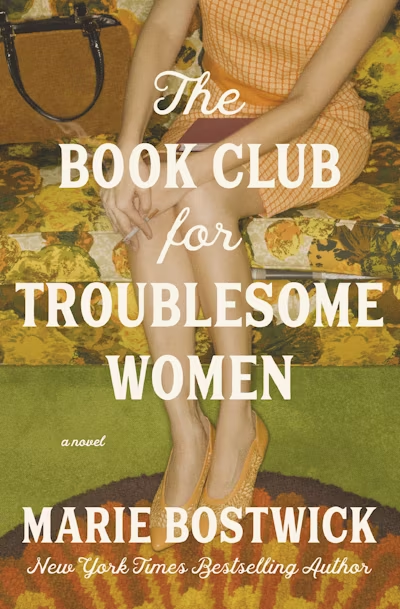
When Margaret moved into her new community, she was looking for a friend.  She didn’t mean to start a book club and she didn’t mean to read The Feminine Mystique, but that is what happened.

In The Book Club for Troublesome Women, Marie Bostwick tells about life in the 60s and how Friedan’s book was one of the sparks that started the women’s movement. For Margaret and her three friends, it was life changing.  We follow these traditional housewives and mothers into their first forays with careers, business, and higher education.

At first, I wasn’t impressed with Bostwick’s book.  The fact that there could be more to a woman’s life than housekeeping is no longer news. But for the younger generations who didn’t live through the 60s, the potential tradwives, it might be an eye opener.

One of the best parts of the book is the message of the importance of support and help that friends can give to each other.  This is a fine piece of social history told through the voices of four thoughtful gutsy women.

The title of Martin Walker’s To Kill a Troubadour brings to mind that well-known title, To Kill a Mockingbird.  In addition to the phrasing, there are the two words, troubadour and mockingbird.  Both refer to things that are musical and sing.  Why did Walker want to make the connection?

Google’s AI reminded me that Harper Lee’s mockingbird symbolizes innocence. In Walker’s story, a young French troubadour has written a song about Catalan independence (the province of Spain that Walker expounds on).  His lovely folk song has become embroiled in a political firestorm.  Spain wants to ban it; France is incensed that one of their own is being censored.  But is the problem really between these two closely related countries or is there a third-party lurking in the background manipulating the situation?

Walker is very interested in the minute details of French Perigord history (his second home). This book reflects that interest as well as international espionage, military history and weapons.  It also gives a nod to devotees of the more personal, cozy mystery genre with a second story line about a woman whose abusive ex-husband has been released from prison.

One of the best parts of Walker’s books are the endearing details about life in the small village of St Denis, especially the delicious food and wine.  His main character, Bruno, casually whips up simple feasts featuring gazpacho from his garden vegetables or capon from the local butcher. I’m always so impressed with his hospitality. Bruno routinely invites old friends, people he has just met, or casual business acquaintances to dinner at his house. Out-of-town visitors are offered his guest room.  His generosity creates a feeling of community and is an example to us all.

I’d like to offer a tribute to Jane Goodall who recently died at age 91.  Jane was a pathfinder, true to herself, who worked at something she loved and believed in until the day she died. We should all be so lucky.

Choosing a Path

Small Things Like These by Claire Keegan is a small book, just over 5 x 7” with 114 pages.  It is the embodiment of its message: small things can have a powerful effect.

The setting is bleak.  It is a rural town in Ireland where residents are not well off.  Factories are closing and people worry about paying the bills; it is cold, windy and gray.  But it is Christmas and people have strung lights, baked something special, shared with their neighbors, enjoyed the warmth of their homes.

The hero, Bill Furlong, owns a business that delivers coal throughout the community. In his 40s, he is having a bit of a crisis – what is it all for?  He looks back on his childhood.  He was the illegitimate son of a single mother who through the kindness of her employers was able to keep her job as a maid in a wealthy house.  They all lived together, and the family treated him well. But the question of his father’s identity plagues him.

One of his deliveries on Christmas Eve is to the convent where unwed mothers work in the laundry.  The nuns also run the only good girls’ school in the area, a school that his own daughters attend.  It is at the convent that he encounters a different kind of crisis.  Bill has seen something he wishes he could ignore.

Earlier on this Christmas Eve day, he had received an unexpected present. Now he must make a difficult choice. How much is he willing to sacrifice to give a gift in return?

In Anne Hillerman’s Shadow of the Solstice, it is the summer solstice, a time of the year that means change is coming. What does that mean for the married couple Chee and Manuelito, two detectives in the Navajo Nation?

Much goes on in Shiprock, New Mexico, that day. A high-level US cabinet secretary in charge of uranium mining contracts may be coming, and the police are on high alert. A cult that opposes any type of mining has rented space nearby to “build a sweat lodge and meditate.”  Meanwhile, Manuelito’s sister, a home health aide, is worried about one of her “oldies” who has disappeared with her grandson.

The detectives have to deal with a lot in one short time period, but the plots are straight forward and easy to follow.  The best and most distinctive part of Hillerman’s mysteries are the warm descriptions of Navajo culture, seamlessly woven into the story.

Many male artists in the past century have given credit to the women in their lives for being their muses.  Beautiful talented women inspired them they said.

But what did the women think of this label?  Maybe they were gifted artists themselves and wanted, and deserved, to be recognized as more than someone else’s inspiration. 

These are the women Lori Zimmer writes about in I’m Not Your Muse. She gives brief summaries of women artists whose work was overshadowed by men – their husbands, lovers, or business partners – because of the societal norms of the times. Her subjects represent a variety of arts from architecture to embroidery to circus performer to writer to painter. 

Her righting of an historical wrong, the subordination of the female partner, is a worthy endeavor.   The problems with the book are that the stories are oversimplified and there are so many individuals mentioned that I forgot the first few after I read about more and more.  What the book does well is give an idea of the breadth of the problem in the art world of the 20th century and whet the appetite to read more about particular individuals.  

I especially liked the ending where she talks about Leonora Carrington, Remedios Varo, and Kati Horna, artists who escaped WWII to become expats in Mexico. There they formed a tight friendship where they helped and supported each other, personally and in their work.  Zimmer writes, “In a society when women still struggle for equality a quarter of the way into the twenty-first century, we should look to Carrington, Varo, and Horna, who chose to uplift each other, to collaborate rather than compete, to celebrate one another instead of letting society put them against each other.”  Amen to that.

While reading this book about talented women, I came across this old New Yorker cartoon:

Cozy Mysteries

Anthony Horowitz’s latest, Marble Hall Murders, is double the value with two complete mysteries in one book.  First, there is the real one, unfolding in the present; second, there is the novel being written by one of the characters.

Susan Ryeland is asked to edit one last Atticus Pund mystery, a continuation novel by a new author (familiar characters if you have read Magpie or Moonflower Murders or seen the tv series). Eliot Crace gives her trouble from the start, and when he tells her that his mystery will reveal a murderer from his childhood, she worries that he could be in danger.

Crace lived with a famous grandmother beloved by fans for her charming children’s books. In real life, she was a dragon hated by her family.  The grandchildren used to dream up ways to murder her. When Susan’s apartment is broken into and trashed, her cat Hugo almost killed by a knife wound, she realizes the past, and its fictionalized version, have intruded into the present.

Horowitz loves anagrams and he has made this whole book into one.  Characters from one story are shuffled around to emerge as different people in the second story.  Poison, betrayal, and deception are present in each of them as Susan and a sympathetic detective solve three murders.  Thumbs up for both stories.

We Solve Murders, Richard Osman’s newest detective agency, ups the ante on the Thursday Murder Club. These new sleuths are professionals!  Fans of the Murder Club mysteries will find the characters, Amy, Steve, and Rosie, just as endearing as the septuagenarian amateurs. 

Amy, who works for one of the best security firms, has been hired to protect Rosie, a feisty bestselling author of indeterminate age who has been getting murder threats.  Ex-policeman Steve, Amy’s father-in-law, might not be content in his quiet retirement.  When Amy’s company is implicated in money laundering and three murders, and she finds herself a target, they get together to unravel the mystery.  The trail leads around the world in private jets and five stars hotels.

This is a lighthearted story with little question about who will prevail.  But its detailed plot, red herrings, and fast action kept me guessing and eagerly turning pages until the very end. We Solve Murders is a worthy successor to the Thursday Murder Club series.

In the song, the Midnight Hour refers to a lovers’ rendezvous.  In the book, The Midnight Hour by Elly Griffiths, the phrase means a time of revenge, a time to pay for a crime.

A retired actor, famous in his day, is found dead in his chair, poisoned. His wife isn’t unhappy. She has put up with his sexual misconduct, affairs, even illegitimate children for a lifetime. Did she finally have enough? 

She hires a detective agency run by two women to prove her innocence and find the murderer.  The two of them work well with the young woman police officer assigned to the case. Is there anyone who wished the dead man harm?  The list, mostly spurned lovers from his past, is very long.

Memories from the old theater days, a music hall, a magician’s act, cold changing rooms, run down hotels, all add to the Brighton, England setting.  The three women and delightful toddler Jonathon navigate their personal lives while investigating the crime. The pace is brisk; the plot intricate but not overwhelming to follow. It’s a satisfying read.

Strong women getting the job done despite lack of support makes a statement, but it is seamlessly done – not a preachy word to be read. The playboy getting his just desserts is great wish fulfillment.

Different Worlds

 In the 1600s, in colonial Jamestown, near the end of “the starving time” winter, a teenage servant girl escaped the death and disease of the fort to take her chances in the wilderness.  In The Vaster Wilds, Loren Groff tells a searing story of her attempt to travel to “the French” where she hopes to find refuge.

The girl was taken from a London poor house at four by a wealthy family to be its maidservant and pet. When she is a teenager, the minister husband decrees they will go to the new world to save souls.  On the voyage, the girl is one of the few who does not become ill, or die, and enjoys a rare time of happiness.

Although we learn about her earlier life through flashbacks, the majority of the story is made up of her weeks in the wilderness. The book has been described as a modern Robinson Crusoe, a survivalist story, or a captivity tale. While she physically escapes her bondage to the minister and his wife, she is still captive to their views of herself: her mother was probably a whore who abandoned her; she is a “zed,” nothing to be noticed; there is no way she is one of the elect.

Yet, this illiterate, uneducated, starving girl finds food and shelter.  But don’t think this is a story about bravery rewarded.  There are no happy Pilgrims in hats having Thanksgiving with the Indians. It is a brutal tale describing the cold indifferent beauty of the world she has chosen and her struggle to survive.  The author doesn’t mince words about the suffering endured. 

The antidote to the terror is the girl’s growing awareness of her place in the natural world and her growing spirituality.  “and the earth itself uncovered its shining face and to her now revealed itself in a litany of wonder… This place and these people didn’t need the English to bring God to them.”  The descriptions of nature are lush and gorgeous.  It is a powerful, but not pleasant, story.

“There are more things in heaven and earth, Horatio,/Than are dreamt of in your philosophy.” Hamlet said that a few hundred years ago, but it is a sentiment that hasn’t gone out of style.  Elly Griffiths, in her latest whodunnit, The Frozen People, plays with the idea.

The detectives in the small cold case department have a secret weapon.  One of their own, a brilliant physicist, has developed a method to take them back in time to observe the actual crime.  Now, Ali, another one of the group, will attempt to “go through the gate” to 1850, much further back than before.  A Parliament minister wishes her to exonerate his great-great-grandfather accused of killing three women.  Ali arrives safely but when it is time to leave, the gate back to the present is closed.

At the same time, in a parallel story, her son who works for the same Parliament minister, is accused of killing him.  Are the murders, almost 200 years apart, connected?

This is a clever story full of twists and very unexpected turns. Griffiths sets the scene, builds tension, develops likable characters, and – surprises us. 

I’m starting to see recurring themes in Griffiths’ works.  In her Ruth Galloway series, the detective, an archeologist, studies the past.  That series, plus several of the author’s other books, include a bit of magic or mysticism.  Now, uniting the two interests, this latest book is about time travel, magically returning to the past.  It hints that there will be a sequel; I look forward to reading it.

The blackberry pickles were as good as we remembered. I first made them, eons ago, when we moved to the country and couldn’t stand to see all the wild blackberries going to waste.  That attitude didn’t last longer than a year, but during that time I discovered In a Pickle or a Jam by Vicki Willder, first published in 1971. 

It is full of the most unusual, intriguing recipes, and is still available, in paperback, on Amazon for $8.00, a great bargain.  Willder lived in Hawaii and so presents recipes such as banana pineapple jam or mango chutney; the more typical cucumber pickles – or okra pickles – if you would like a change; papaya seed dressing (another favorite) or tangerine marmalade.

What was too much work when I was younger, working, and busy, was, in my present retirement, fun – especially since a friend, who still has acreage, volunteered to pick the blackberries.    We have something good to eat plus a topic of conversation. Blackberry pickles?

The term “joyspan,” is a new word coined by Kerry Burnight, a professor of geriatrics, to refer to how much happiness we find in later life.  I’m interested in the subject but have found that books on aging are often wordy platitudes, so I was pleased to read a succinct summary of Joyspan

To thrive as we age, the author says, there are four nonnegotiable things we must do: grow, adapt, give, and connect. Good enough. I’m happy with this summary and not planning to read the book.

In keeping with the idea of continued growth, here is some new vocabulary: