Different Paths

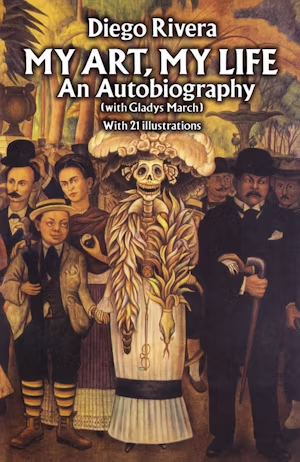
Luckily, Gladys March, the co-author of My Art, My Life by Diego Rivera, warns in the forward to the book that Rivera was a mythologizer, or mythomaniac.  His exaggeration is part of his voice, she says, necessary for an accurate portrait.

In this autobiography, Rivera tells some stories about his childhood: between two and four years of age he was allowed to roam the woods with only a goat to watch over him; he had his first sexual experience at 9 with a voluptuous 18-year-old; at 10, he was a military genius who astounded the generals.  Hmmm.

The bulk of the book emphasizes his dedication to painting.  He describes individual murals and what he hoped to accomplish in them; we hear his side of the many controversies he was embroiled in.  There are opinions about his contemporaries, his travels, and studies. 

Viewpoints on the Mexican political scene, his belief in communism and dislike of capitalism appear throughout.  He proclaims a love for the peasants, but the stories he tells are all about the wealthy heads of government and business who sought his company and bought his paintings.

Women, his four wives and numerous sexual exploits, make up the third major part of his story.  He looks at them with an artist’s eye: “Lupe was a beautiful, spirited animal…the curves and shadows of that wonderful creation…” The end of the book has a short essay from each wife.

Usually when we hear about Rivera, it is about his accomplishments, his painting genius. In this book, we hear his opinions in his own voice. He doesn’t do himself any favors.  He had a large ego that craved attention, a disdain for conventions, and a love of chaos and excitement. (Sound familiar?) He saw the world from a different perspective. Maybe it is too hard for someone to be a revolutionary artist and conventional at the same time.              

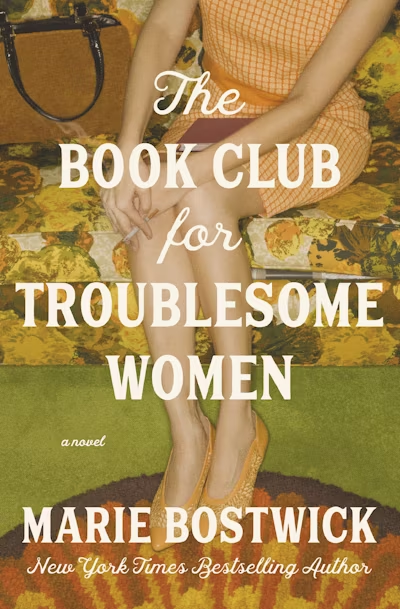
When Margaret moved into her new community, she was looking for a friend.  She didn’t mean to start a book club and she didn’t mean to read The Feminine Mystique, but that is what happened.

In The Book Club for Troublesome Women, Marie Bostwick tells about life in the 60s and how Friedan’s book was one of the sparks that started the women’s movement. For Margaret and her three friends, it was life changing.  We follow these traditional housewives and mothers into their first forays with careers, business, and higher education.

At first, I wasn’t impressed with Bostwick’s book.  The fact that there could be more to a woman’s life than housekeeping is no longer news. But for the younger generations who didn’t live through the 60s, the potential tradwives, it might be an eye opener.

One of the best parts of the book is the message of the importance of support and help that friends can give to each other.  This is a fine piece of social history told through the voices of four thoughtful gutsy women.

The title of Martin Walker’s To Kill a Troubadour brings to mind that well-known title, To Kill a Mockingbird.  In addition to the phrasing, there are the two words, troubadour and mockingbird.  Both refer to things that are musical and sing.  Why did Walker want to make the connection?

Google’s AI reminded me that Harper Lee’s mockingbird symbolizes innocence. In Walker’s story, a young French troubadour has written a song about Catalan independence (the province of Spain that Walker expounds on).  His lovely folk song has become embroiled in a political firestorm.  Spain wants to ban it; France is incensed that one of their own is being censored.  But is the problem really between these two closely related countries or is there a third-party lurking in the background manipulating the situation?

Walker is very interested in the minute details of French Perigord history (his second home). This book reflects that interest as well as international espionage, military history and weapons.  It also gives a nod to devotees of the more personal, cozy mystery genre with a second story line about a woman whose abusive ex-husband has been released from prison.

One of the best parts of Walker’s books are the endearing details about life in the small village of St Denis, especially the delicious food and wine.  His main character, Bruno, casually whips up simple feasts featuring gazpacho from his garden vegetables or capon from the local butcher. I’m always so impressed with his hospitality. Bruno routinely invites old friends, people he has just met, or casual business acquaintances to dinner at his house. Out-of-town visitors are offered his guest room.  His generosity creates a feeling of community and is an example to us all.

I’d like to offer a tribute to Jane Goodall who recently died at age 91.  Jane was a pathfinder, true to herself, who worked at something she loved and believed in until the day she died. We should all be so lucky.

Choosing a Path

Small Things Like These by Claire Keegan is a small book, just over 5 x 7” with 114 pages.  It is the embodiment of its message: small things can have a powerful effect.

The setting is bleak.  It is a rural town in Ireland where residents are not well off.  Factories are closing and people worry about paying the bills; it is cold, windy and gray.  But it is Christmas and people have strung lights, baked something special, shared with their neighbors, enjoyed the warmth of their homes.

The hero, Bill Furlong, owns a business that delivers coal throughout the community. In his 40s, he is having a bit of a crisis – what is it all for?  He looks back on his childhood.  He was the illegitimate son of a single mother who through the kindness of her employers was able to keep her job as a maid in a wealthy house.  They all lived together, and the family treated him well. But the question of his father’s identity plagues him.

One of his deliveries on Christmas Eve is to the convent where unwed mothers work in the laundry.  The nuns also run the only good girls’ school in the area, a school that his own daughters attend.  It is at the convent that he encounters a different kind of crisis.  Bill has seen something he wishes he could ignore.

Earlier on this Christmas Eve day, he had received an unexpected present. Now he must make a difficult choice. How much is he willing to sacrifice to give a gift in return?

In Anne Hillerman’s Shadow of the Solstice, it is the summer solstice, a time of the year that means change is coming. What does that mean for the married couple Chee and Manuelito, two detectives in the Navajo Nation?

Much goes on in Shiprock, New Mexico, that day. A high-level US cabinet secretary in charge of uranium mining contracts may be coming, and the police are on high alert. A cult that opposes any type of mining has rented space nearby to “build a sweat lodge and meditate.”  Meanwhile, Manuelito’s sister, a home health aide, is worried about one of her “oldies” who has disappeared with her grandson.

The detectives have to deal with a lot in one short time period, but the plots are straight forward and easy to follow.  The best and most distinctive part of Hillerman’s mysteries are the warm descriptions of Navajo culture, seamlessly woven into the story.

Many male artists in the past century have given credit to the women in their lives for being their muses.  Beautiful talented women inspired them they said.

But what did the women think of this label?  Maybe they were gifted artists themselves and wanted, and deserved, to be recognized as more than someone else’s inspiration. 

These are the women Lori Zimmer writes about in I’m Not Your Muse. She gives brief summaries of women artists whose work was overshadowed by men – their husbands, lovers, or business partners – because of the societal norms of the times. Her subjects represent a variety of arts from architecture to embroidery to circus performer to writer to painter. 

Her righting of an historical wrong, the subordination of the female partner, is a worthy endeavor.   The problems with the book are that the stories are oversimplified and there are so many individuals mentioned that I forgot the first few after I read about more and more.  What the book does well is give an idea of the breadth of the problem in the art world of the 20th century and whet the appetite to read more about particular individuals.  

I especially liked the ending where she talks about Leonora Carrington, Remedios Varo, and Kati Horna, artists who escaped WWII to become expats in Mexico. There they formed a tight friendship where they helped and supported each other, personally and in their work.  Zimmer writes, “In a society when women still struggle for equality a quarter of the way into the twenty-first century, we should look to Carrington, Varo, and Horna, who chose to uplift each other, to collaborate rather than compete, to celebrate one another instead of letting society put them against each other.”  Amen to that.

While reading this book about talented women, I came across this old New Yorker cartoon:

Cozy Mysteries

Anthony Horowitz’s latest, Marble Hall Murders, is double the value with two complete mysteries in one book.  First, there is the real one, unfolding in the present; second, there is the novel being written by one of the characters.

Susan Ryeland is asked to edit one last Atticus Pund mystery, a continuation novel by a new author (familiar characters if you have read Magpie or Moonflower Murders or seen the tv series). Eliot Crace gives her trouble from the start, and when he tells her that his mystery will reveal a murderer from his childhood, she worries that he could be in danger.

Crace lived with a famous grandmother beloved by fans for her charming children’s books. In real life, she was a dragon hated by her family.  The grandchildren used to dream up ways to murder her. When Susan’s apartment is broken into and trashed, her cat Hugo almost killed by a knife wound, she realizes the past, and its fictionalized version, have intruded into the present.

Horowitz loves anagrams and he has made this whole book into one.  Characters from one story are shuffled around to emerge as different people in the second story.  Poison, betrayal, and deception are present in each of them as Susan and a sympathetic detective solve three murders.  Thumbs up for both stories.

We Solve Murders, Richard Osman’s newest detective agency, ups the ante on the Thursday Murder Club. These new sleuths are professionals!  Fans of the Murder Club mysteries will find the characters, Amy, Steve, and Rosie, just as endearing as the septuagenarian amateurs. 

Amy, who works for one of the best security firms, has been hired to protect Rosie, a feisty bestselling author of indeterminate age who has been getting murder threats.  Ex-policeman Steve, Amy’s father-in-law, might not be content in his quiet retirement.  When Amy’s company is implicated in money laundering and three murders, and she finds herself a target, they get together to unravel the mystery.  The trail leads around the world in private jets and five stars hotels.

This is a lighthearted story with little question about who will prevail.  But its detailed plot, red herrings, and fast action kept me guessing and eagerly turning pages until the very end. We Solve Murders is a worthy successor to the Thursday Murder Club series.

In the song, the Midnight Hour refers to a lovers’ rendezvous.  In the book, The Midnight Hour by Elly Griffiths, the phrase means a time of revenge, a time to pay for a crime.

A retired actor, famous in his day, is found dead in his chair, poisoned. His wife isn’t unhappy. She has put up with his sexual misconduct, affairs, even illegitimate children for a lifetime. Did she finally have enough? 

She hires a detective agency run by two women to prove her innocence and find the murderer.  The two of them work well with the young woman police officer assigned to the case. Is there anyone who wished the dead man harm?  The list, mostly spurned lovers from his past, is very long.

Memories from the old theater days, a music hall, a magician’s act, cold changing rooms, run down hotels, all add to the Brighton, England setting.  The three women and delightful toddler Jonathon navigate their personal lives while investigating the crime. The pace is brisk; the plot intricate but not overwhelming to follow. It’s a satisfying read.

Strong women getting the job done despite lack of support makes a statement, but it is seamlessly done – not a preachy word to be read. The playboy getting his just desserts is great wish fulfillment.

Different Worlds

 In the 1600s, in colonial Jamestown, near the end of “the starving time” winter, a teenage servant girl escaped the death and disease of the fort to take her chances in the wilderness.  In The Vaster Wilds, Loren Groff tells a searing story of her attempt to travel to “the French” where she hopes to find refuge.

The girl was taken from a London poor house at four by a wealthy family to be its maidservant and pet. When she is a teenager, the minister husband decrees they will go to the new world to save souls.  On the voyage, the girl is one of the few who does not become ill, or die, and enjoys a rare time of happiness.

Although we learn about her earlier life through flashbacks, the majority of the story is made up of her weeks in the wilderness. The book has been described as a modern Robinson Crusoe, a survivalist story, or a captivity tale. While she physically escapes her bondage to the minister and his wife, she is still captive to their views of herself: her mother was probably a whore who abandoned her; she is a “zed,” nothing to be noticed; there is no way she is one of the elect.

Yet, this illiterate, uneducated, starving girl finds food and shelter.  But don’t think this is a story about bravery rewarded.  There are no happy Pilgrims in hats having Thanksgiving with the Indians. It is a brutal tale describing the cold indifferent beauty of the world she has chosen and her struggle to survive.  The author doesn’t mince words about the suffering endured. 

The antidote to the terror is the girl’s growing awareness of her place in the natural world and her growing spirituality.  “and the earth itself uncovered its shining face and to her now revealed itself in a litany of wonder… This place and these people didn’t need the English to bring God to them.”  The descriptions of nature are lush and gorgeous.  It is a powerful, but not pleasant, story.

“There are more things in heaven and earth, Horatio,/Than are dreamt of in your philosophy.” Hamlet said that a few hundred years ago, but it is a sentiment that hasn’t gone out of style.  Elly Griffiths, in her latest whodunnit, The Frozen People, plays with the idea.

The detectives in the small cold case department have a secret weapon.  One of their own, a brilliant physicist, has developed a method to take them back in time to observe the actual crime.  Now, Ali, another one of the group, will attempt to “go through the gate” to 1850, much further back than before.  A Parliament minister wishes her to exonerate his great-great-grandfather accused of killing three women.  Ali arrives safely but when it is time to leave, the gate back to the present is closed.

At the same time, in a parallel story, her son who works for the same Parliament minister, is accused of killing him.  Are the murders, almost 200 years apart, connected?

This is a clever story full of twists and very unexpected turns. Griffiths sets the scene, builds tension, develops likable characters, and – surprises us. 

I’m starting to see recurring themes in Griffiths’ works.  In her Ruth Galloway series, the detective, an archeologist, studies the past.  That series, plus several of the author’s other books, include a bit of magic or mysticism.  Now, uniting the two interests, this latest book is about time travel, magically returning to the past.  It hints that there will be a sequel; I look forward to reading it.

The blackberry pickles were as good as we remembered. I first made them, eons ago, when we moved to the country and couldn’t stand to see all the wild blackberries going to waste.  That attitude didn’t last longer than a year, but during that time I discovered In a Pickle or a Jam by Vicki Willder, first published in 1971. 

It is full of the most unusual, intriguing recipes, and is still available, in paperback, on Amazon for $8.00, a great bargain.  Willder lived in Hawaii and so presents recipes such as banana pineapple jam or mango chutney; the more typical cucumber pickles – or okra pickles – if you would like a change; papaya seed dressing (another favorite) or tangerine marmalade.

What was too much work when I was younger, working, and busy, was, in my present retirement, fun – especially since a friend, who still has acreage, volunteered to pick the blackberries.    We have something good to eat plus a topic of conversation. Blackberry pickles?

The term “joyspan,” is a new word coined by Kerry Burnight, a professor of geriatrics, to refer to how much happiness we find in later life.  I’m interested in the subject but have found that books on aging are often wordy platitudes, so I was pleased to read a succinct summary of Joyspan

To thrive as we age, the author says, there are four nonnegotiable things we must do: grow, adapt, give, and connect. Good enough. I’m happy with this summary and not planning to read the book.

In keeping with the idea of continued growth, here is some new vocabulary:

Endings and Beginnings

One of the more powerful books I’ve read lately is The End of Drum-Time by Hanna Pylvainen. Set near the Scandinavian Arctic Circle about two hundred years ago, it is the story of the end of a way of life.

Drum-time represents the ancient ways, when the indigenous people’s lives revolved around the reindeer whose migration they followed, and the drums they used for healing and spirituality.  The Lapps, or Sami as they called themselves, defined the end of drum-time as when the Christians came.

This is a traditionally structured novel – no interspersing of past and present – which is itself a message.  The groundwork is laid and the plot builds to an inexorable climax. The old must give way to the power of the new; the two cannot coexist.

The setting is developed: the stark beauty of ice and snow, the constant cold and need for heavy furs, the inadequacy of the smoking hearth, breaking ice in the bucket to make coffee.  A minister (based on a real person) preaches in the small church where he has been sent to convert the heathen. The Sami come to town for supplies and the now available alcohol; they occasionally go to church. Main characters are introduced: some are herders; two are the minister’s daughters.

As the story begins, both the townspeople and the herders are stunned when a Sami leader converts and joins the church leaving his son to manage their herd alone. At this time, the two daughters also face choices.  One falls in love with a herder and follows him; the other stays home and dutifully marries the shopkeeper. Their personal stories illustrate the grander turmoil.

This is a perceptive portrayal of the conflict between the modern state and church versus traditional ways of life.  It is also a superbly told story with sympathetic characters.  I so wanted things to work out well for them.

Avocado toast, avocado smoothies, chips and guacamole, all things Americans currently take for granted didn’t exist in this country fifty years ago.  In Green Gold, Sarah Allaback and Monique F. Parsons trace the rise of the avocado from wild trees growing in Mexico and Central America to an American dietary staple spreading across the globe.

In an encyclopedia of detail, they tell about the “dreamers;” people who brought the first fruit to the U.S. over a hundred years ago.  Small orchards were planted; the first avocados were sold to luxury restaurants; the industry was on its way.

At first glance, it might seem like this book would have a limited audience.  How many people really want to know about the avocado’s journey to their plate? But it isn’t a narrow story.  Anyone who has tried to make a living in agriculture will sympathize with sudden freezes, root rot, fungus infections. Anyone connected with the produce industry will understand the difficulties of standardization, developing a packing system, storing, cooling, transporting.  Gardeners will be interested in pollination, varieties, soil types, fertilization.

Those of us in the Oregon wine industry have lived through a similar story as we saw our new industry develop.  We also had to learn how to grow and produce our product and at the same time create a market for it.  Our task may have been easier though, as potential customers knew what wine was.  Not so for the avocado.

One of the most charming parts of the book are the recipes at the beginning of each chapter. They are chronological and it was fun to start with recipes from the early 1900s and watch them change.  I read every one.

Avocado Sailboat Salad

It is one of the easiest salads in the world to prepare. Cut one of the large avocados into quarters.  You now have an avocado boat.  To make it a sailboat, just insert a square cracker, point downward, into the prow of the boat.  Fill the boat with a cargo of your favorite fruit – little oranges are particularly good looking sliced, using a cheese cracker sail.           Los Angeles Times 1932

Reading this book and writing about it was a tribute to my botanist friend Maureen who lived her life to the fullest.  Well into her 70s, she continued to work at a job she loved, grafting avocados, some from the seeds we saved for her, helping to develop the next new variety.

I haven’t written about the “and More” part of Old Ladies Read and More for a while, but I’ve been inspired lately as I have seen my 55+ friends take up new activities. 

One is part of a music duo playing traditional folk music plus their own work at local venues.  My favorite originals were “Don’t Let This Gray Hair Fool You” and “Climate Jane” (superhero). They are The Ribbon Ridge Girls, Alanna and Kelsey.

Another has recently become interested in showing her long-haired dachshund and invited me to my first ever dog show.  It is a whole world of very specific standards based on the history of the animal.  The dachshund, for example, was bred to go down badger holes, and is judged accordingly.

Here’s a joke I read that will appeal to those who still can remember their high school French:

Two catamarans are in a race.  One is called, “One two three” and the other is “un deux trois.”  Which one won?

“One two three” because “Un deux trois cat sank”

Questions

The purpose of Arecibo, the observatory in Puerto Rico, is to listen for transmissions from intelligent life in outer space.  In her fantasy/fiction novel The Sparrow, Maria Doria Russell tells what happens when it receives such a transmission.

In her story, the Jesuits, who have a history of traveling to new worlds, launch a crew of eight to find the source.  What has been heard at the observatory is music, beautiful haunting singing. The structure of the book is a horizontal V; two story lines, starting far apart, meet on the planet of Rakhat. One of the lines begins with goose bumps, when Jimmy, manning the telescope, realizes what he is listening to, thus setting in motion the odyssey to outer space.  The second plot line starts at the opposite end, when one of the priests returns to earth in disgrace years later, and then moves back in time to his experience on the planet.

The fantasy of a new world and space travel provides the platform for Russell to explore religious and philosophical questions, which are what the book is really about.  She is particularly interested in God’s involvement in our lives.  If God loves human beings plus controls everything that happens in the world, (including the falling sparrow), why do terrible things happen to us?  How can we continue to have faith?

A second, less overt question, arises at the end of the book as the author examines just how much control more intelligent powerful beings should have over less able species. Raising them for food is the example but the morality of eating meat is not the issue; Russell is interested in bigger, more existential topics.

Can it still be a good book if you dislike the characters?  Such is the situation in The Hypocrite by Jo Hamya. In one section, the father, a writer, is spending the summer with his teenage daughter expecting her to type his latest creation and ignoring her the rest of the time.

In another, the daughter, grown and a playwright, has produced a bitingly unpleasant play about that summer together.  In a third, the daughter is having dinner out with her mother who is loud and drunk and long divorced from the father. The possible boyfriend preens and thinks he is God’s gift.  

And yet – I kept reading. The emotions depicted were raw and immediate. Underneath their self-absorption and entitlement, the characters were vulnerable human beings craving love and attention – and I couldn’t help but be sympathetic.  Maybe this book is a good lesson for our time. The people we dislike want the same things as everyone else and often have a hard time getting them.

This sounded like the perfect book for me – Ladies’ Lunch by Lore Segal.   I loved the way it started: “Five women have grown old coming together, every other month or so, for the last thirty or more years.”  I have friends like that, although there are fewer now that we lost one last month.

But it wasn’t what I hoped for.  This is a series of vignettes about the very old – late 80’s and 90’s and how they manage to get together and what they talk about. For example – two of them meet at the usual café for lunch.  They reminisce, joke, make future plans, but have to leave when their adult children come to collect them.  One is in a wheelchair and the other no longer drives. They will meet again whenever the children can arrange it.  In another story, there is the twenty minute rule: they may talk about their health issues for only twenty minutes. In all the little stories, there is this large looming undercurrent of the debilities of old age.  Too realistic?

To end on a happy note:

It makes me laugh every time.

Challenging Reading

As science advances, it becomes harder for the average person to keep up with what is going on in areas that have become more and more specialized. Understanding the vocabulary is itself a challenge. A term like quantum physics is becoming too broad – and how many of us even understand what it means?

Richard Holmes in The Age of Wonder talks about a different time, approximately 1800, when poets could still understand, discuss, and write about new discoveries, and the average educated person could grasp what was going on. “Science” was a new word to describe the excitement and advances of the age.

It was a time of discovery.  There were first visits to Tahiti, Hawaii, and the African interior. William Herschel and his sister Caroline developed new telescopes and realized there were millions more galaxies (never mind stars) out there, and that the universe was not static but evolving. Humphry Davy articulated the scientific method and started the branch of science known as chemistry. Men doffed their hats when they watched a balloon actually rise from the ground under its own power.

The book was sometimes funny such as when Davy, writing to the woman he was wooing, told her that her letters caused a sensation in him higher than “exhilatory gas.”  True, he was doing air/gas experiments, but still.

This nonfiction book is too detailed, but it gives a good description of the wonder and fears of people as new information contrasted with old beliefs. It gives a picture of the time which was the beginning of today’s technological revolution.

For a giant change of pace in fiction, there is Leonora Carrington who is both a painter and writer. Her Surrealist paintings are full of unusual images and her short stories follow suit. 

In “The Oval Lady” she features a ten-foot-tall adolescent who can turn herself into a horse. There is “The Debutante” whose main character sends a dressed-up hyena to take her place at dinner.  The stories increase in weirdness from there. 

But the points of these stories are ideas that a 21st century reader can embrace.  Carrington doesn’t want women to be confined to expected, strait jacketed roles.  She doesn’t think women exist only to inspire men but are capable of being great artists themselves. She wants to be free to innovate and that she certainly does.

Her stories are just a few pages long and can be found free online.  It’s easy to read one or two to get a taste, and you might be inspired to read a bit about Surrealism.  I read them with an art museum book group and learned about a different world.

In Rogue Justice, Stacey Abrams’ main character is out for revenge. Hayden has been wronged by the system, specifically military justice and the courts, and she retaliates on a grand scale.

Hayden was made to feel powerless and now she will literally take away power from everyone else. In this thriller we are tutored on details about the US electricity grid – and how susceptible it is to a terrorist attack.  So many cyber security organizations are mentioned it is hard to keep track.  The main character is a brilliant idealist hot on the trail. We recognize the criminally inclined president (during his first term).

I admire Stacey Abrams, the woman from Georgia who served in its House of Representatives, has been responsible for expanding voting rights, plus finds time to write novels.  This however, isn’t my favorite kind of mystery.  I like something cozy that I can relax with, not something difficult to follow that makes me worry about Armageddon.  For those who like something intricate, fast paced, and exciting, it might be just the thing.

Reading to Relax By

Peace Like a River by Leif Enger is an unusual mix. It is a straightforward story of an eleven-year-old boy, Reuben, who has a life-changing experience. It is a Western told in poems written by his younger sister.  It is a quest as the family searches for a lost brother.  It is a portrait of a man of strong faith who casually performs a miracle now and then.

The book is very good at foretelling and setting the scene.  It opens one icy day with the family out hunting geese.  As one nears, Reuben is handed the rifle by his older brother.  He is now man enough to take the shot.  It is only the first of many adult behaviors that will be asked of him.  While I’m not usually fond of books about hunting, especially birds, this is a rural family hunting for dinner. 

The pace of the story is slow with plenty of storytelling and meandering, but tension grows.  By the end I was galloping through to see what would happen.  Afterwards, I went back to slowly read one of the final scenes which was as beautiful a description of a possible afterlife as I have ever read.

I waded ashore with measureless relief…the bank was a waving slope of knee high grasses…the water appeared gold as on your favorite river at sunup… moving up from the river the humming began to swell – it was magnetic, a sound uncurling into song and light…

While I wouldn’t describe this as a “Christian” book, there are strong overtones of faith and religion, and the miracles are real.  It is not magical realism because everyone recognizes that the events are extraordinary, thus raising questions about the presence of the supernatural in our lives.

You are Here by David Nicholls is a second time around romance.  Both main characters are divorced and say they are embracing solitude.  But their mutual friend worries that they are lonely and arranges a group walking holiday.

This is a formulaic story – two people meet but hardly pay attention to each other.  Little by little they do start to notice, and attraction develops. Troubles intervene. But the pleasure of the novel is in the details and the story is compelling. How exactly will they finally get together?

The coast-to-coast walk across the middle of England evokes the beauty of a wild landscape as well as the memorable experience of pouring rain and fog. Cozy pubs in the evening are a nice counterpoint. The characters are very likeable.  I would have been disappointed if it hadn’t ended well.

At first, I didn’t realize The Hunter by Tana French was a mystery.  The scene is set in rural Ireland; the main characters are introduced; conflict and family problems begin.  There are no signs of murder.

Cal, a retired policeman from the states is helping to rescue and mentor somewhat neglected and delinquent Trey, a bright teenage girl whose father has abandoned the family.  When Dad suddenly returns home their relationship is threatened.

Dad didn’t come alone.  He brought an Englishman who claims his family came from their small Irish town.  This acquaintance has stories, passed down for generations, of a vein of gold running through the town.  The townspeople, suffering from a drought and worried about their farms, need distraction and listen to the story.  The scene is set.

As the plot unfolds, the author explores the customs and ethics of the small village.  She examines the loyalty friends and family have for each other and the difference between the legal and the moral.

French, known as The First Lady of Irish Crime, is a successful mystery writer whose stories have been made into a television series, Dublin Murders.  I also enjoyed her short essay on why people like to read mysteries which you can find at this link, Why Mystery Books are So Satisfying.

I hope everyone enjoyed National Library Week, April 6-12

Instructions on Aging

Wise Aging by Linda Thal and Rachel Cowan is a compilation of information for those aspiring to be an elder or sage in their old age.  Emotional characteristics necessary to achieve such a goal are discussed in detail. The authors, a rabbi and an educator, have provided a self-help manual with probing questions to spark an inner exploration, instruction in meditation and journaling.

Some of their comments were thought provoking.  They ask, “Who is wise?” and answer “The person who can learn from everyone.”  I liked their definition of forgiveness: “giving up the resentment to which you are entitled and offering friendlier attitudes than they are entitled.”  “A well-aged person is someone people want to visit not have to.”

A lot of the information was a rehash of ideas I had heard before. There is much talk about gratitude, which must be an “in” subject. Wisdom sounds desirable, but do I really want to spend my old age on self-improvement so that I may become more compassionate, generous, forgiving, grateful, patient?  Whew!  Maybe wisdom, and old age, are about more than that.

An alternate presentation on aging is Still Life at Eighty by Abigail Thomas. This memoir is an example of the joy of reading good literature. The sentences are original and inciteful; the stories are poignant and humorous. Thomas’s emphasis is not on improving herself but on finding things to get excited about despite diminishing years and capabilities.

Possibility is a physical sensation and there’s nothing like it.  I remember the first time I felt its thrill, listening to my father describe something that was going well in his lab…he fairly trembled with excitement…

She writes vignettes about what she did during Covid, memories that surfaced, people and things she used to love. Through these delightful stories, there is insight into isolation, loneliness, memory loss, paying attention, nameless dread, and anxiety. Here are some favorite quotes:

In the intro: Don’t smile at us as if we’re cute or pat our hand and call us dear.  A little respect please.

You can do a lot with a cane; you can use its rubber tip to shove a door shut, which is satisfying if you’re in a bad mood; …

 Unforgettable advice: Always take a cookie when the plate is passed.

I can think of my failing memory as an accomplishment.  I am finally living in the moment.

While the first book was chock full of serious suggestions and advice on how to improve, the second was realistic about how people think and behave – and it was funny. 

Strong Women

In the early 1900s, a young Chinese girl was taken to the fortune teller.  When he could not say for sure that she would marry and produce sons, it was decided that she would be the child in the family sold to the silk factory. Harvests on their small farm had been poor and extra money was needed.

In Women of the Silk, Gail Tsukiyama tells what life was like for girls like Pei, our main character. Raised on a small rural farm that had fish and mulberry leaves for its cash crops, she was taken by her father one morning to the nearby town. Without any idea of what was happening, she was dropped off at the factory dormitory. She was eight years old.

The other girls and young women, all in the same situation befriended her.  The relationships among them unfold against the backdrop of the silk factory.  We learn how silk was produced and the conditions of factory life. 

This segment of Pei’s life ends when she is in her 20s and escapes to Hong Kong to avoid the Japanese who have invaded China. I wonder if the author’s Chinese ancestors had direct experience with this time as she has written before about the brutality of the Japanese army.

Author Marie Benedict is interested in women whose accomplishments have been overlooked by history. In The Personal Librarian she teams up with Victoria C. Murray to trace the career of Belle de Costa Greene who developed the J. P. Morgan library at the beginning of the twentieth century.

Morgan was interested in rare manuscripts and had haphazardly amassed a valuable collection.  He was looking for a librarian to bring some order to it when his nephew introduced him to Belle.  She was a jewel.  Not only did she catalog his acquisitions, she also guided him in adding to his collection.  Rare books, first printings from the original printing press, illuminated manuscripts, all were her forté. She could spot a forgery or misrepresentation. Plus, she was a skilled negotiator when most women, in the early 1900s, just didn’t do that sort of thing.

The second story in this book of historical fiction was about Belle’s personal life.  She was born a “colored girl” in the South just after Reconstruction.  Her educated parents enjoyed success in that period, a respite between slavery and Jim Crow.

As Reconstruction passed and federal troops left the South, segregation and prejudice once again became ascendant. The family moved north and faced a choice.  They were light skinned and could pass as white.  Should they?  Belle’s father said no and fought for equality.  Her mother, less optimistic, said yes and took the children, thus giving them opportunities they never would have had.  Belle, moving in sophisticated circles in a high-powered job, presented herself as white with a Portuguese ancestor to account for her darker skin. 

The private library she directed became public one hundred years ago.  As part of its centennial celebration last year, there was an exhibit honoring Belle, acknowledging her accomplishments and mixed-race background. Her secret had been kept until 1999 when a Morgan researcher discovered her birth certificate listing her as “colored” and naming her father, Richard Greener, who was a well-known black advocate for racial justice.

The Raging Storm by Ann Cleeves is the third and most recent of the Matthew Venn series.  Cleeves, 70, creator of the Vera and Jimmy Perez series, is an accomplished, popular author whose many books have been turned into television programs.

This newest detective, Matthew, was raised in an evangelical community in rural England where he found belonging and acceptance until he came out as gay and married his love.  Shunned by the church and rejected by his parents, he found a new community in the police force and rose to the rank of detective inspector.

In this story he and his two sergeants are called to solve the murder of a popular sailing figure, dead in a small boat apparently arranged to be found.  Matthew remembers the place.  It was here that he spent a happy childhood as part of the Brethren. But now, pouring rain, roaring winds, and high tides add to the gloomy atmosphere as the three officers follow a dangerous trail that twists through old flames, jealousy, illness and aging.

We recently visited the John Young Gallery at the University of Hawaii and saw a wonderful collection of woodblock prints each of which depicted a Japanese folk tale.

This one tells the story of a man who visited the undersea dragon palace.  After being entertained there for a few days, he returned home to find he had been gone three hundred years. I was reminded of our Rip Van Winkle story and interested to see the same fable about this modern physics concept (of time moving at different speeds), in two very different cultures.

Old Ladies Read and More

A blog directed towards adults who like to read

Skip to content ↓