
When the author Chloe Dalton is out walking one evening she sees a leveret, or newborn hare, in the grass strip in the middle of the lane. Concerned that she will make things worse, she leaves it alone, only to find it still there when she returns. Moved by its helplessness, she takes it home.
Although she knows nothing about taking care of a wild animal, she turns out to be a sensitive caregiver. Raising Hare is her memoir about this experience. The wild hare shares her home, when it chooses, for at least three years and she records her close observations of its appearance and behavior, much of which is in contrast to scarce written information or folk tales. If you always thought that hare was another name for rabbit, you will find yourself effortlessly and pleasantly educated.
This story was written during Covid when Dalton was in lockdown in the countryside. She accepted the little animal as an unexpected gift during dark times. It also inspired her to think generally about mankind’s relationships with animals and our obliviousness in how we interfere with their needs for food and a home.
In an interview, Dalton was asked: “Can you describe your book as an item on a menu?” She answered: “I’d like to think that it would be something unpretentious, nourishing, warm and comforting. Something homemade, and simple. Freshly made bread, perhaps, with a touch of salt.”

Another piece of nature writing comes from the Nature Conservancy magazine about someone else discovering new information about a little-known species. The Mexican long-nosed bat is the primary pollinator for the succulent agave, of interest to margarita drinkers.
How are scientists discovering what its migration route is? “We put together long telescoping poles, like painters’ poles, and we shove a long Q-tip into the end of it. We raise that pole up 20, 30 feet in the air to swab the agave flowers when they are open. We collect the saliva or hair or whatever the bats left behind…”
What a scientist won’t do for information! (Found in the 75th anniversary issue, 2026)

In Yesteryear by Caro Claire Burke, Natalie, pregnant with her sixth child, lives on a farm with her family in a self-sufficient lifestyle. Meals are made from organic foods from scratch, and the children are home schooled. She loves being a traditional housewife, or so she tells her millions of followers on social media.
It is all a performance. There are two nannies to care for and educate the children she hardly sees. The inept husband hires ranch hands to do the work while he follows fringe chat groups online. A hired professional curates all the information seen on her accounts.
Until one day Natalie wakes up and it is no longer a show. She has been transported back to the 1800s and must live her chosen lifestyle for real. Burke has not written a fantasy time travel novel, but a “true” story, thus creating a huge plot problem. She does solve the two-hundred-year time span issue, but it feels very contrived.
Burke co-produces a podcast called Diabolical Lies and uses this book to continue its conversation about many social issues. She has plenty to say about the tradwife culture, doomsday preppers, Evangelical views of a woman’s place, and the hypocrisy of it all. The subjects are timely and the beginning very engaging, but then the story stumbles along requiring a great deal of suspension of disbelief and memory of that literary device, the unreliable narrator.
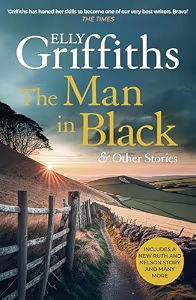
Elly Griffiths fans will be pleased to know she has published a collection of short stories, some mysteries and some not. The Man in Black brings back some of her best-known characters along with some new ones.
Ruth Galloway and DCI Nelson, living together now, win a cruise to Egypt. On board, he receives a mysterious note asking him to protect one of the passengers. When she is almost killed by a falling rock and her husband dies, Nelson’s instincts kick in. He and Ruth have their suspicions but must leave things to the Egyptian police. In another story, a young woman detective riding a chair lift on holiday, looks down to see a body floating in a swimming pool.
Other stories are prequels. We meet Harbinder Kaur on her first day of work as she navigates telling her new partner and team that she still lives with Mom who has prepared a box lunch of fragrant(?) Indian food and that she would consider being fixed up with a girlfriend. We see Max Mephisto at the beginning of his career, just trying out his disappearing woman act. When someone disappears for real, observant Max has a good idea where she went.
Not a mystery is the story about Ruth bringing home a Christmas tree for her two-year-old daughter Kate. After decorating the tree, she and her friend, the wizard Cathbad, go to the kitchen to fix mince pies and mulled wine. When they return, “the Christmas tree is lying on the floor surrounded by broken baubles and Kate and Flint (the cat) are sitting in the middle of the chaos wearing tinsel crowns and identical expressions of satisfaction.”
Griffiths’ ability to create a scene and likable characters in just a few strokes make these short, charming stories a joy to read.

Discover more from Old Ladies Read and More
Subscribe to get the latest posts sent to your email.